I Asked Three AI Systems to Show Me the CFO of the Future. Here’s What They Disagreed On - and Why It Matters.
I gave three leading AI systems the exact same prompt:
Generate an image of The AI CFO.
Same words. Same intent. No additional guidance.
What came back, now captured in a single composite image, looks cohesive at first glance. Three versions of a senior finance leader. Three data‑rich environments. Three confident presences anchored by dashboards, forecasts, and digital interfaces.
But look more closely, and the disagreement is obvious.
Not about what a CFO looks like, but about what a CFO is for.
That distinction matters more than any aesthetic difference.
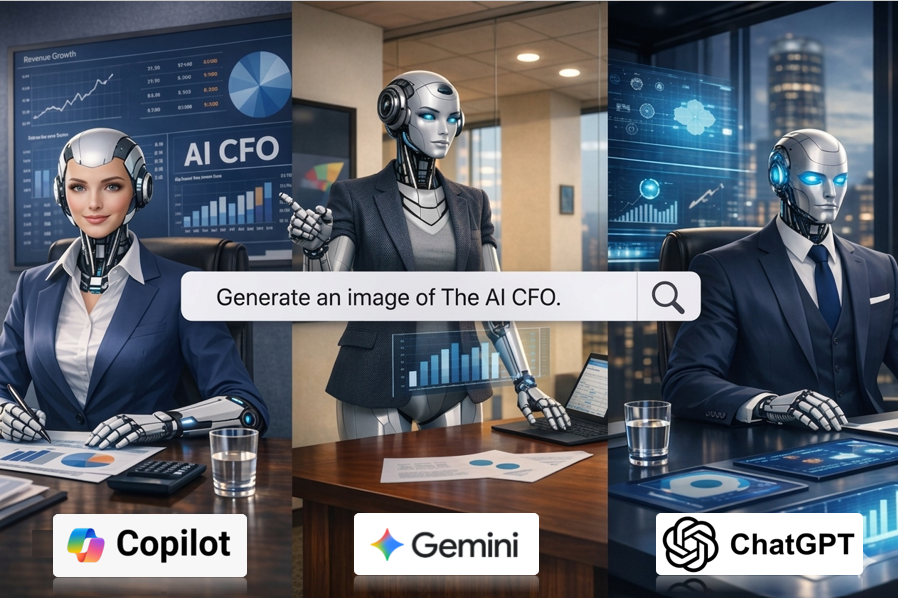
Three images. Three theories of finance leadership.
The image on the left (generated by Copilot) places the CFO firmly at the desk. Reports are laid out. Screens sit behind. The posture suggests continuity with today’s finance function: stewardship through control, authority rooted in proximity to the numbers. The CFO appears embedded in execution, close to reconciliations, forecasts, and operational cadence.
The image in the centre (generated by Gemini) tells a different story. The CFO is upright, engaged, mid‑interaction with both people and data. Analytics are present, but they are not the focal point - interpretation is. This version of the role emphasises explanation, translation, and narrative. The CFO here looks like a bridge between systems and stakeholders.
The image on the right (generated by ChatGPT) shifts again. Data is no longer something the CFO handles - it surrounds them. Dashboards feel ambient, almost infrastructural. Authority comes not from touching the numbers or explaining them, but from orchestrating a system that already knows how to calculate.
Same prompt. Three philosophies:
CFO as operator
CFO as sense‑maker
CFO as system governor
AI didn’t resolve the question. It surfaced it.
What the images reveal about where finance is headed
Across all three images, one thing is consistent: analytics are abundant. Forecasts, charts, indicators, and simulations are everywhere. That part of the future seems settled.
What isn’t settled is what humans are meant to do once the analysis exists.
In the left‑hand image, the CFO still appears to be producing insight — reviewing outputs, validating numbers, staying close to the machinery of finance. This reflects organisations where AI augments work but does not redefine roles.
In the centre image, the CFO is positioned as a translator. Insight exists, but value is created by framing implications, aligning stakeholders, and guiding decisions. Here, AI accelerates analysis, but judgment remains visibly human.
In the right‑hand image, insight is assumed. The CFO’s role is no longer about understanding the data itself, but about governing the environment in which decisions are made. The question shifts from “Is this forecast right?” to “Is this system acceptable, controlled, and trusted?”
These are not artistic flourishes. They are competing organizational futures.
The quiet disagreement about accountability
The most important difference between the three images is subtle, but decisive: where accountability appears to sit.
In one, accountability feels operational — grounded in review and oversight. In another, it feels relational — grounded in explanation and influence. In the third, it feels systemic — grounded in architecture, controls, and design.
AI can generate insight at scale. It can surface anomalies, run scenarios, and optimise outcomes faster than any human team. But it cannot do one thing:
It cannot be accountable.
Someone still has to own the consequences of decisions informed by AI systems. Someone still has to face regulators, boards, auditors, and markets. Someone still has to decide what is acceptable risk — not just statistically, but ethically and legally.
That responsibility doesn’t disappear as intelligence scales. It concentrates.
Why this matters now
Finance is reaching a hand‑off moment.
For decades, the CFO role was defined by scarcity: limited data, limited visibility, limited processing power. AI removes that scarcity almost entirely. What remains is judgment, governance, and trust.
The composite image makes this visible. All three AI systems agree that the CFO remains central. What they disagree on is why.
Is the CFO there to manage complexity? To explain it? Or to design systems that can be trusted to handle it?
This is not an abstract debate. It shapes how finance teams are structured, how talent is developed, and how risk is governed in AI‑enabled organisations.
The real takeaway
When I asked three AI systems to show me the CFO of the future, they didn’t converge on a single answer.
But they did converge on a truth.
The CFO is no longer defined by producing numbers.
The CFO is defined by what happens after the numbers appear.
In the era of AI, analysis becomes abundant. Accountability does not. The future CFO - whether human, augmented, or system‑enabled - is the one who owns that gap.
That is the hand‑off this moment demands.
And it’s why the conversation about the AI CFO isn’t really about technology at all. It’s about governance, judgment, and the enduring need for someone to stand behind decisions when the system has already spoken.

